
AGGREGATE & QUARRY ASSOCIATION
Rock our Future school competition


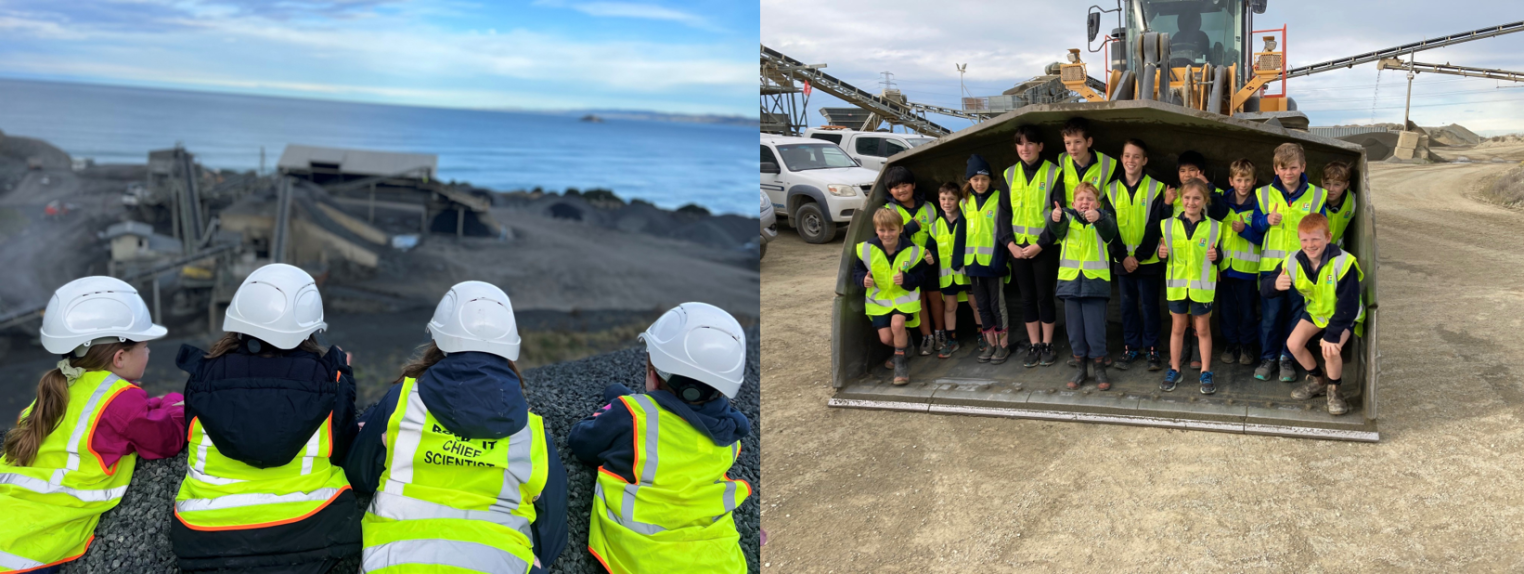
2026 Competition
📋Overview
Your school could win up to $4,000 with this exciting project for years 5-8, as well as either a $100 Prezzy Card for the individual winning students in each year, or a $200 Prezzy Card per winning group per year. Link it to your social sciences, technology, science, or writing/arts learning. Aggregate (crushed rock, gravel and sand) makes up the bulk of products we quarry in New Zealand. Students are encouraged to visit a local quarry and ask lots of questions to help with their projects.
🌍 What is this competition about?
Quarries play an important role in building and supporting our communities – they provide aggregate that is used for things like roads, buildings, and other infrastructure we use every day. The purpose of this competition is to help students understand what quarries are and why we need them.
🎯 Brief
All entries must:
- Explain what a quarry is
- Explain why we have quarries
- Explain what aggregate is used for (e.g. roads, buildings, infrastructure etc.)
- Include at least two sustainability practices used by quarries
🎨 How students can present their entry
Students may choose ONE of the following:
- Digital presentation (slides)
- Video or animation
- Poster
- Essay or written report
📋Competition details
- Projects need to be sent to us by the end of Term 3, Friday 25th September 2026. Please complete the entry form for your school and return it to [email protected].
- Judging will take place in October with winners announced in November 2026.
- Prizes:
- 4 x prizes of $1,000 to the school of each winning entry (1 winner per year group)
- 4 x prizes of $100 Prezzy Cards for each of the individual winning students, or $200 for a winning team (1 winner per year group)
Teachers, parents and students are encouraged to approach their local quarries for a visit to obtain information for the projects or you can use our list of quarry contacts.
📥 How to submit your entry
Please complete the entry form and ensure that each student’s name, year group, and school are clearly included with their entry.
Email the completed entry form together with the project to [email protected]. For large files or multiple files, we recommend using WeTransfer, which is a simple and free file‑sharing option.
If submitting a physical entry by post, please attach a copy of the entry form to each project and send to:
PO Box 10‑668
Wellington 6140
New Zealand
make default visible
2025 Competition
The Brief: To demonstrate the lifecycle of a quarry, including what to do with the land at the rehabilitation stage of the lifecycle – bonus points were for sustainable rehabilitation ideas. Students had the option to present their ideas through a digital presentation, video, poster, a model, essay or written report.
Lifecycle of a quarry:
- Identify where the rock and/or sand is and test it is suitable, environmental and cultural studies conducted
- Consent and approval for operations – get permission from the council to extract the material
- Opening the pit in stages, putting in place environmental and safety measures
- Site is active, extraction of quarried material happens in stages
- Rehabilitate the site for future long-term use
Criteria
The project had to include:
- The lifecycle of a quarry
- Demonstrate basic understanding of what quarrying is and why it’s important in New Zealand
- Submission types (choose one):
-
- A 2–3 minute video or animation
- A digital slideshow (e.g. PowerPoint, Google Slides)
- A written report (max 500 words)
- A poster or infographic (digital / scanned / posted)
- A model with an explanation (photos and a short write-up)
-
THE WINNERS
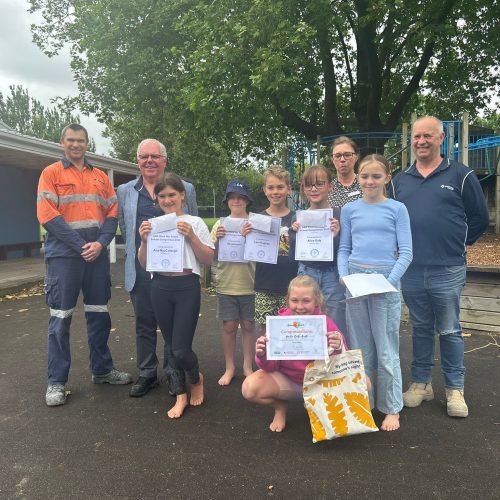
Schools from Auckland to Queenstown were among the winners in the AQA’s Rock our Future school competition for years 5-8 in 2025. The winners from Karāpiro School were, Levi Hughes, Eli Johnson and Aria MacCallaugh with their movie, and Ronya Epp and Alice Daly with their video and model.
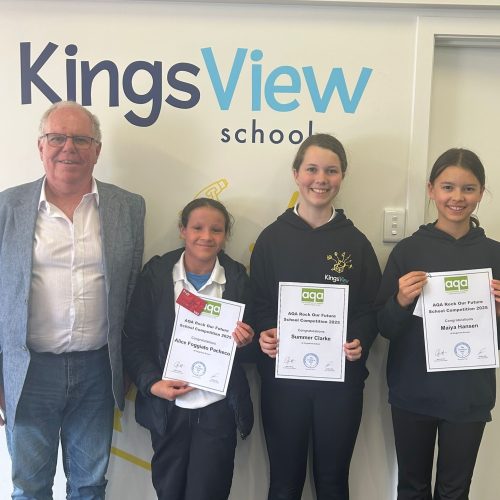
The Year 7 winners were Summer Clarke, Alice Foggiato Pacheco and Maiya Hansen from KingsView School with their presentation.
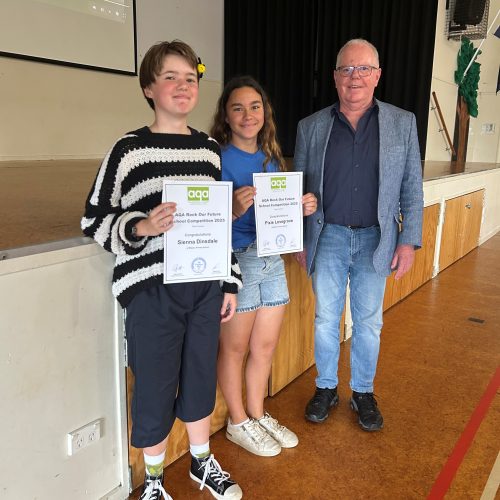
Year 8 winners were Sienna Dinsdale and Pixie Lovegrove from Waiuku School with their presentation.
2024 Competition
The Brief: This year’s brief was for each student to write a poem exploring aggregate in New Zealand highlighting benefits, an explanation of what it is, and what it’s used for.
The poem had to include the following:
Where does aggregate come from
What is aggregate
Why we need aggregate in everyday life
THE WINNERS
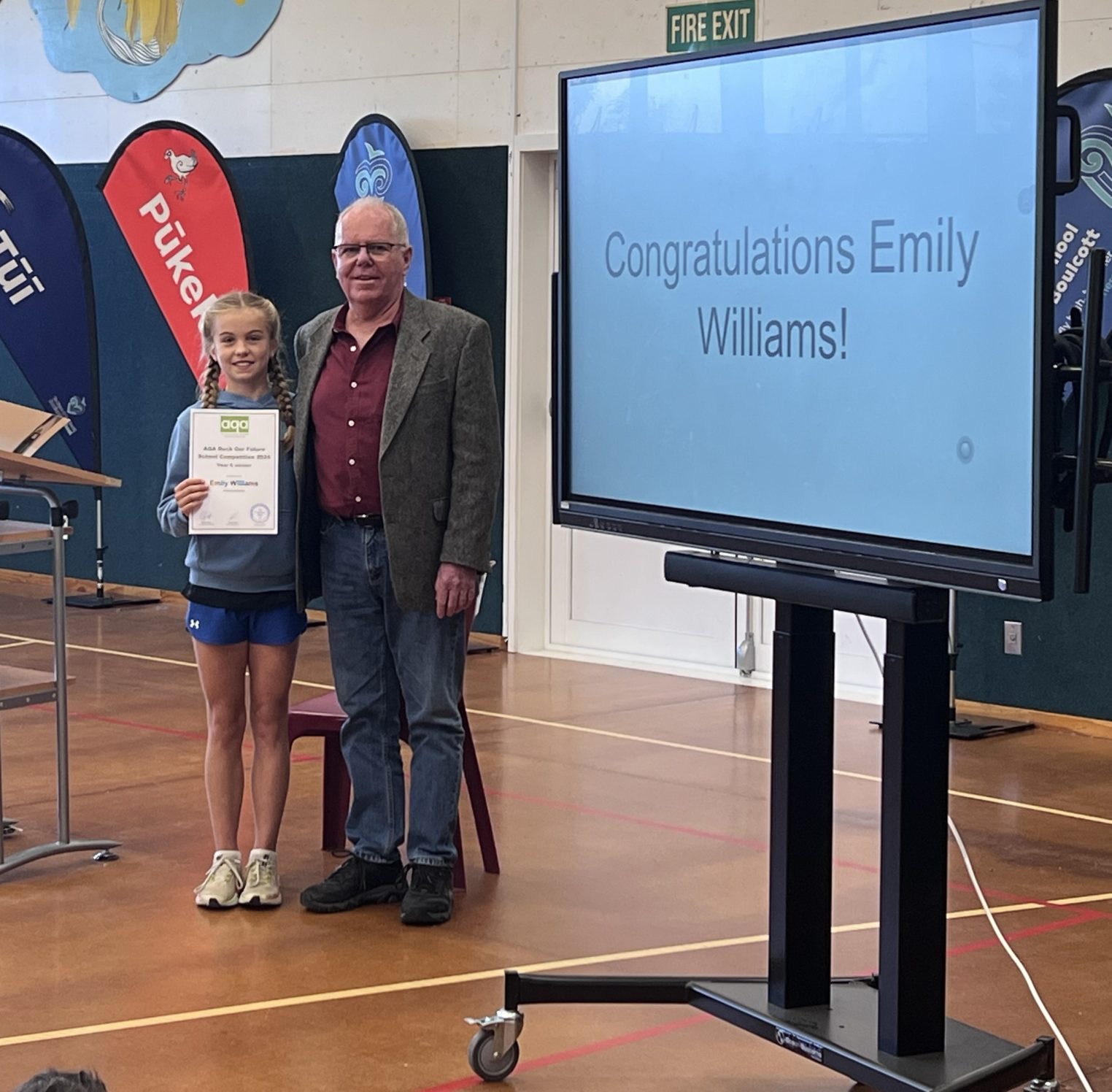
Schools from Wellington to Christchurch were among the winners in the AQA’s Rock our Future school competition for years 5-8 in 2024. The Year 5 winner was Louis Goodman from North East Valley Normal School, Dunedin, and the Year 6 winner was Emily Williams from Boultcott School, Lower Hutt, Wellington.
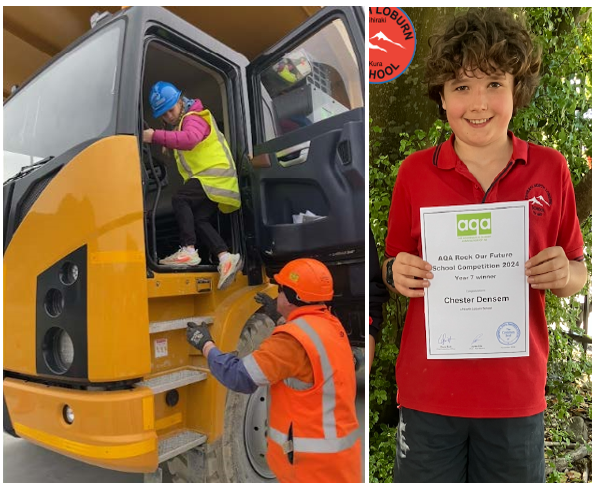
The Year 7 winner was Chester Densem and Year 8 winner was Elenor Eleanor from North Loburn School in Loburn.
2023 Competition
The Brief: This year’s brief was for students to show three everyday uses of aggregate along with an explanation. They were encouraged to visit a local quarry and design a poster.
THE WINNERS
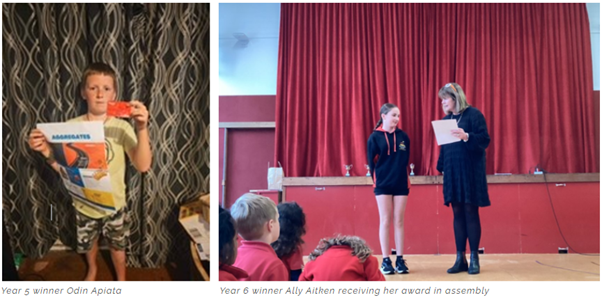
Schools from Northland to Otago were among the winners in the AQA’s Rock our Future school competition for years 5-8 in 2023. The Year 5 winner was Odin Apiata (left) from Ohaeawai Primary School, Northland, and the Year 6 winner was Ally Aikten (right) from Mornington School, Dunedin.
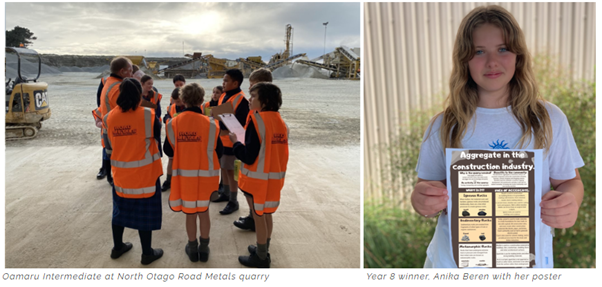
The Year 7 winner was Ana Kaufana from Oamaru Intermediate, and pictured below the Year 8 winner was Anika Beren from Springbank School in Northland.
Read all about their entries here.
2022 Competition
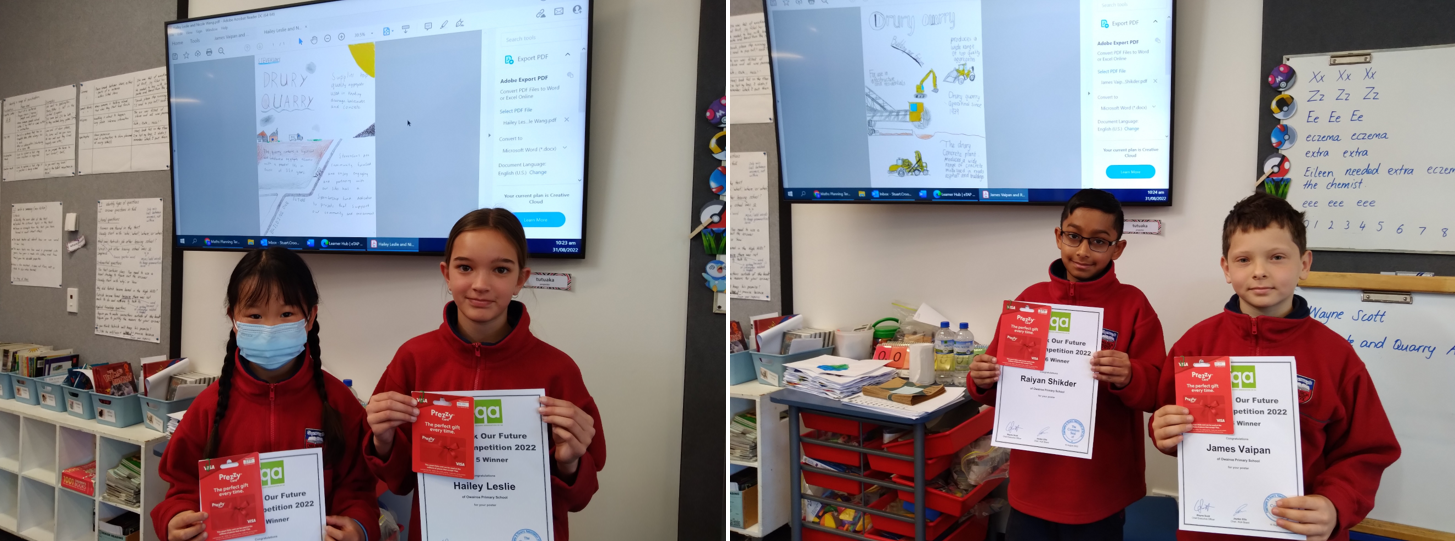
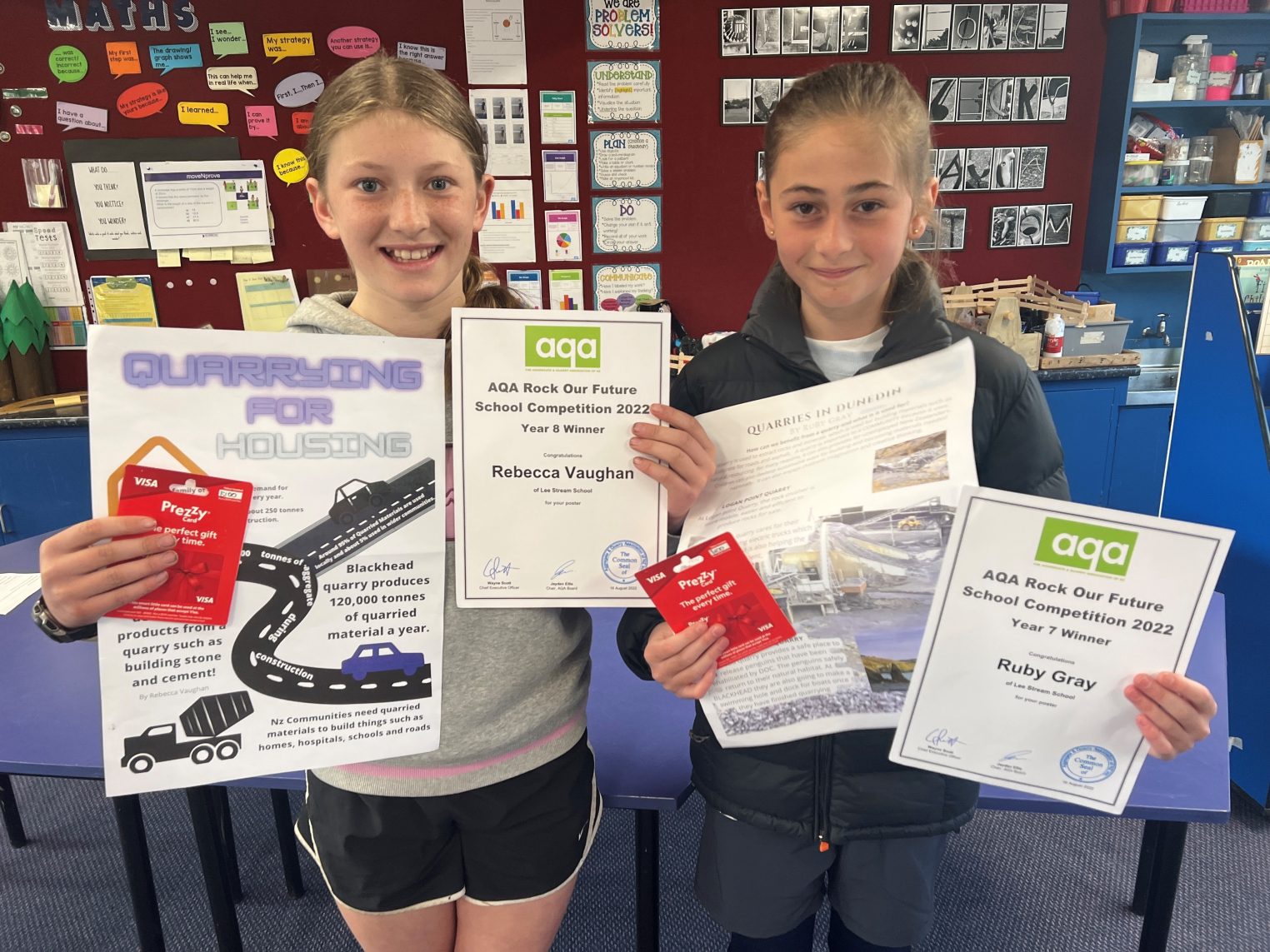
The Brief: Students were encouraged to visit a local quarry and design a poster of an activity at the quarry, why the quarry is needed, and the benefits the quarry provides to the community.
THE WINNERS
Year 5 & 6 winners below from Owairoa Primary School, Auckland
Year 7 & 8 winners below from Lee Stream School, Otago:
Read all about their entries here.
2021 Competition
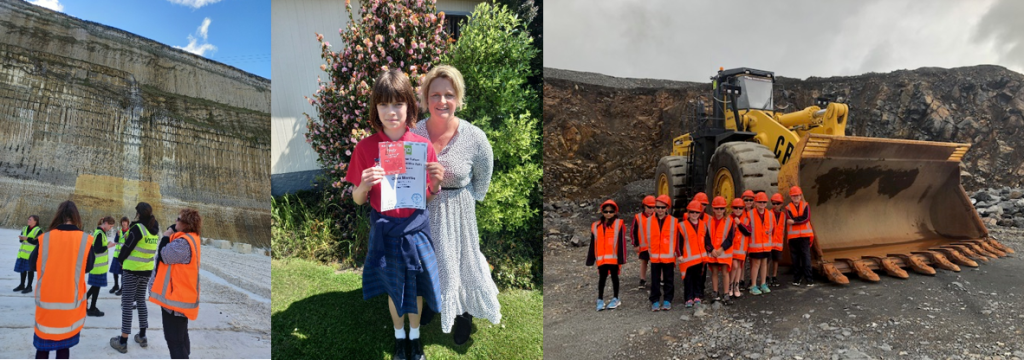
The brief was: Students were encouraged to visit a local quarry and write an essay of no more than 500 words describing their experience at the quarry and what they learnt during the visit.
THE WINNERS
Year 5 & 6 winners were from Puni School, Auckland, and a Year 8 winner from Oamaru Intermediate. There were no Year 7 entries this year.
Read all about their entries here.
2020 Competition
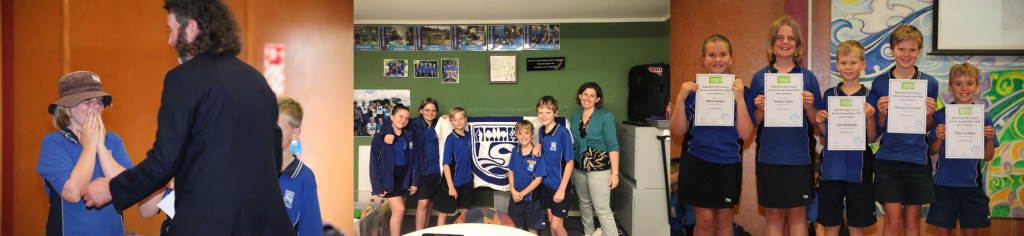
Students were to design a final use for a quarry that has finished extracting rock.
The brief was: You have been hired by a quarrying company called Big Rock Solutions. The company has completed extracting rock from its quarry and now wants to turn the quarry into an asset for the community. They want the land to be useful, and whatever it is turned into to be sustainable, environmentally sensitive and add value to the local community. Neighbours and others in the community need to be considered in whatever final use is designed for the site.
THE WINNERS
Two schools from the Waikato and Manawatū took away the prizes.
Read all about their entries here.
2019 Competition
The brief was: students had been hired by a quarrying company currently exploring the problem of what to do when energy produced by diesel and coal (both non-sustainable energy sources) runs out. The students were to design a solution for the production of aggregate, including crushing plant, and mobile vehicles such as loaders, excavators etc. for the 21st Century.
THE WINNERS
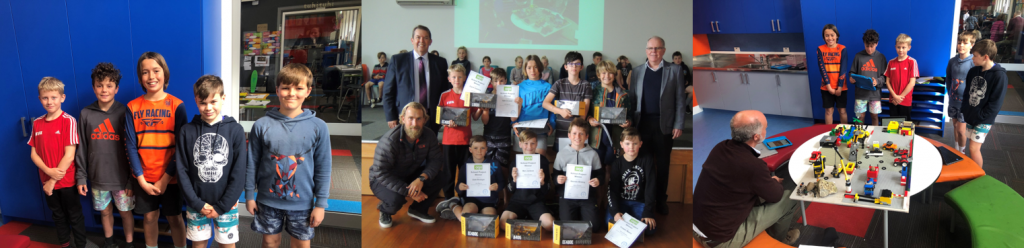
Two groups of boys from Fitzroy School in New Plymouth have taken out the prizes and were awarded by CEO Wayne Scott and MP Jonathan Young on Friday Oct 25th.
Read all about their entries here.
MORE LIKE THIS
DOWNLOADS
AFFILIATED ORGANISATIONS







ABOUT QUARRYING IN NEW ZEALAND
USING AGGREGATE
Aggregates are the most consumed bulk product in the world after water. New Zealand uses 9-10 tonnes of aggregate every year for each adult and child.
BUILDING NZ
To build an average house, you need about 250 tonnes of aggregate - for use in concrete, asphalt, mortar and building products.
OUR COMMUNITY
The quarry industry is committed to working alongside local communities and follows stringent planning, environmental and operating conditions.